Preparing, Shooting and Editing: Events

Updated: Oct 3, 2023
In this post, I want to take the opportunity to share some of the photos from the 2022 Christmas Services of Riverwood Church Community (Winnipeg, Manitoba, Canada) with the theme 'The Art of Christmas' and debrief a little about preparing, shooting and editing. Gallery links are at the end of this post. There's a lot I could write here but I will only share a relative few for now:
PREPARATION: Make sure you're prepared. For example: camera batteries charged (and more than 1 camera battery) and format cards (SD, CF or other) before you start shooting.
PREPARATION: Consider a shot list. For instance, the leader for the specific church service, program or event may have specific shots in mind that they want. I would ask them if they do. They may say they're fine leaving that up to me. Either way, it's good to know what you want to capture before you start shooting. And some PiiiX Photographers may want to be given a shot list, and I am happy to provide that. However, even if you use a shot list, I encourage you to embrace the creative and spontaneous and try to be always be open shots that you see. For example, (coloured stage lighting shining on structure can be interesting to include in your composition or framing.
PREPARATION: Print out two sheets with 'RESERVED' on them and reserve two seats in the first row (if at The Warehouse). At least for myself, one chair is for myself and the second is for my camera bag. I find it too hard to quickly changes lenses if I try to only use one chair. At The Factory, you can do this, or (with permission from the staff videographer) shoot from the video camera platform. At The Firehall, it's mostly picking a place at the back of the room where you have a decent line of sight/angle, and/or moving around. Arrive early enough to do this (before people are sitting in those seats).
COURTESY & ACCOMMODATION: Be careful and mindful of not getting people in an image who don't want their photo taken. Do you have a right? In the community - yes. But does that lead to healthy relationship? Can you at Riverwood church program? Well, signs are posted at the doors that photography (and videography) may occur. But, does not being sensitive and accommodating lead to healthy relationship? Sometimes, it's good to ask a person if it is okay if you take their photo. While people usually don't mind, some are politely clear that they would prefer not, thank you.

RESPECT: Don't use or share images of people in unflattering positions.
COMPOSITION: When composing your shot and people are involved, be mindful of where the edges of your frame is. For example, you want to avoid the bottom edge being just below, on or above a person's crotch or groin. Depending on the person's shape, try to stay near or above the person's belt/pant line or waist. For women, be mindful of where their bust is in relation to the bottom frame edge.
COMPOSITION: A well-composed image should be easily and quickly 'readable' - not too cluttered and so forth.
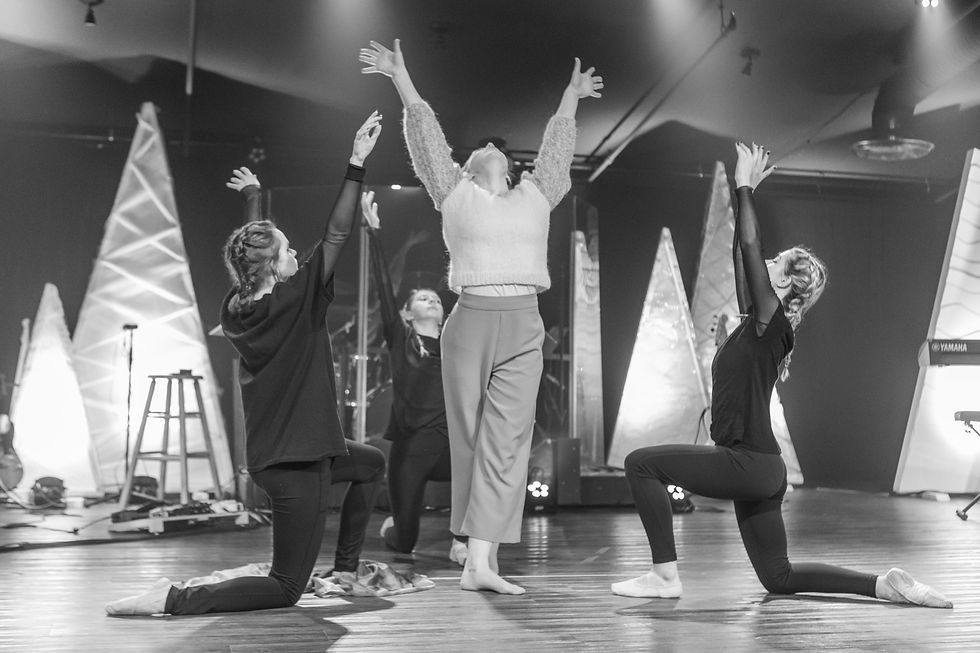
COMPOSITION: You can also incorporate the stage structure, and stage lights on it, into your image composition and framing. In the following image, there seemed to a nice 'red' theme throughout wardrobe, lighting and structure.

And here is an example of lit stage structure being incorporated.

FOCAL POINT: Be intentional about what your camera is focusing on. And, be consistent in monitoring on what your camera is focusing. Adjust as needed.

THE EYES: It is said, 'The eyes are the window to the soul'. Be mindful of a person's eyes. If the pupils being seen are important or will enhance the photo, ensure they are visible and in focus.

CANDID versus POSED: Sometimes I capture images in a natural environment (i.e. a volunteer serving coffee or hors d'oeuvres) but sometimes I ask if I can take their picture (i.e. if they can pose for the camera - i.e. a volunteer look at the camera).


LIGHTING: Use any available natural light to your advantage. (And get it BEHIND YOU versus in front of you).
LIGHTING: Know when you simply need a flash. But - beware - 1) Staff and worshippers really don't want flashes going off during a service or program; 2) Flashes can really change the look(/capturing) of an image - not always for the better. But, if one is needed - it is needed.
LIGHTING: It's a challenge. Even one stage in one venue (i.e. The Warehouse) - the lighting varies significantly from the front third of the stage to the middle or back thirds. And the lighting varies at different parts of the stage overall. Be ready to monitor and adjust continuously. (This Christmas seemed to be dimmer and more challenging than last Christmas.)
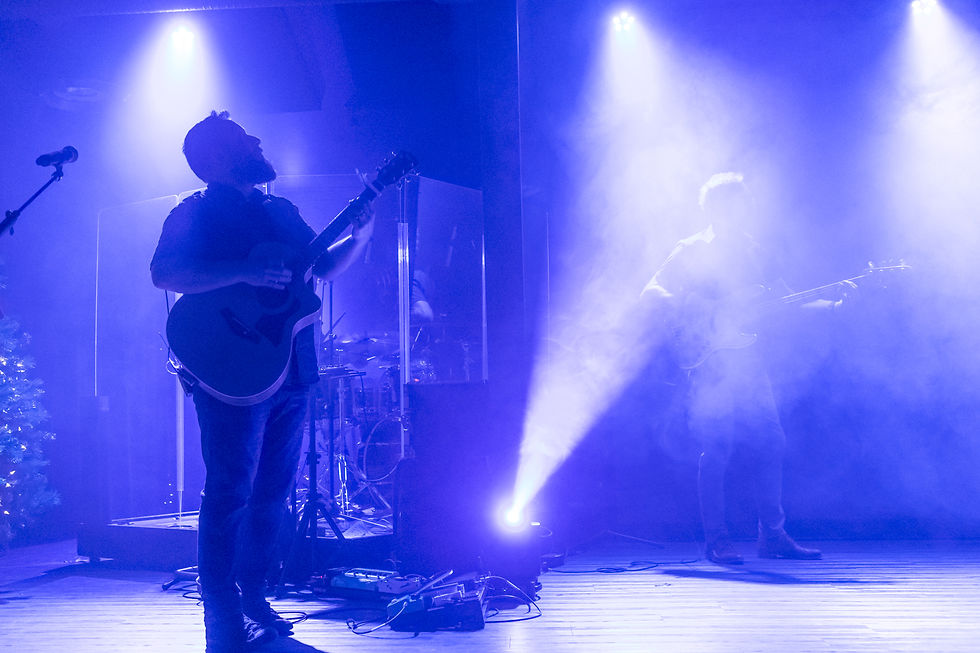
LIGHTING: Have fun! Get creative? For example, watch for silhouette shot possibilities during times of service element transitions/lighting transitions. Sometimes a light shining right behind a person's head creates interesting backlighting. Or a bright shining right at you leads to interesting possibilities. (The image immediately below is from the Christmas 2021 services. See also 'Music' below for some more relevant images.)
DEPTH OF FIELD (re: APERTURE): Set your aperture to get the depth of field that you want. However, in low lighting situations (i.e. a Christmas Eve services) you will likely not have a lot of choice. I usually need to shoot at f2.8 - using f2.8 lenses (ideally that have 'image stabilization' - but not all of mine do.)
LEVELS: Sometimes it's nice to incorporate the back, upper stage lights into the image. To do this, I often 'slouch' or 'slide' down in my front row chair. This often to accomplishes the (slightly lower) level that is needed. (Sitting on the floor would be too low.)

MUSIC: Be mindful of environmental considerations when shooting live music. This can include things that you may want to include into your image composition. For example, moving stage lights, stage fog, change of stage light colour, etc.. (The following five images are from Christmas 2021).

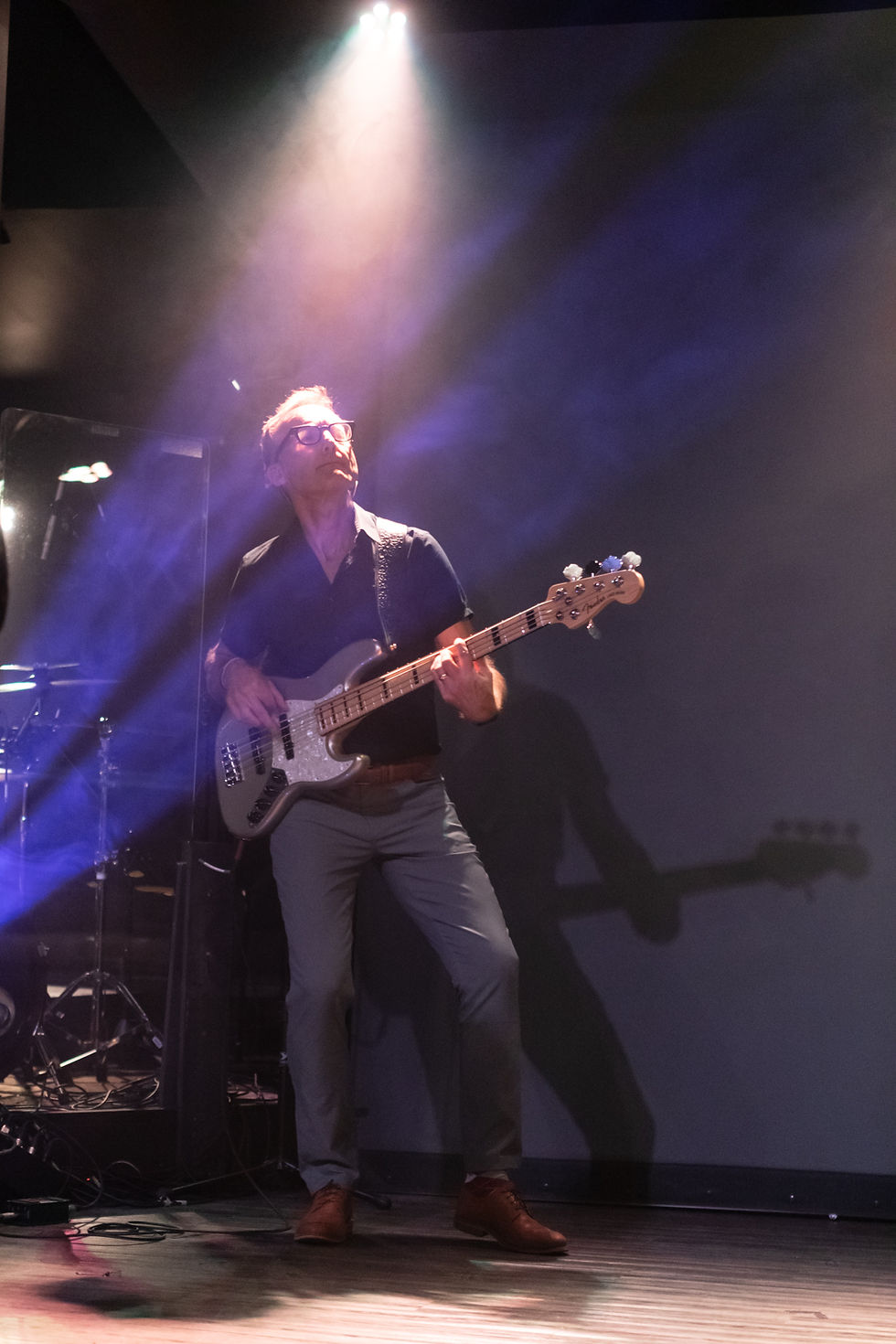


COMPOSITION and COLLISIONS. A good challenge (yes - it's a challenge!) is to TRY to see if there is an angle where you can get all the singers (or dancers) in the front row AND all the musicians in the back two thirds of the stage - so that they are each in view and nobody is standing behind somebody else (which is one example of a 'collision' - and which leads to an image that is not as easy to 'read'). Also try to watch for distracting collisions. For example, half of somebody's guitar cut off by the person standing in front of them or their music stand.


And, in this image, a singer's arm is in the frame but, in my opinion, the arm isn't a collision but actually adds to the 'instrument and vocal' aspect of the music.

FOCAL LENGTH: Be careful when using wide angle lenses. Unless you mean and want to, don't tilt them up or down. The view and image will change dramatically! Usually, just keep a wide angle lenses looking straight ahead.

BURST: There are times when it's good to sue (low or high speed) burst (multiple frames per second). For dance, I almost always do. Depending on your preference, you could also use it when somebody is speaking. It's amazing how many images captured of a person speaking has their mouth/lips in a 'pucker' shape. Using burst can help to ensure that you are more likely to get at least one good (non-puckered) image. However, the downside of this is that this will involve more work for you when you are editing the images afterwards. Either way, you want to capture multiple images (either manually or via burst) to ensure you get at least one good one.


EDITING: Sometimes images shot in colour don't need or aren't enhanced by the colour. So, I often think those images look better in black and white (monochrome), as you can see by some of the images above. Sometimes I will export both versions.
And, now, here are links to the full galleries of the images. Each bullet is its own link that will take you to that gallery. You can then return here by clicking on the browser's 'back' arrow:
Host and Speaker (aka Pastors Todd Petkau and Brittany Petkau)
Comments